In this section, you’ll find resources related to mental health conditions. SCIP updates these resources regularly to provide the most up-to-date information available. If you would like additional information on any behavioral health condition, please contact your SCIP School Coordinator.
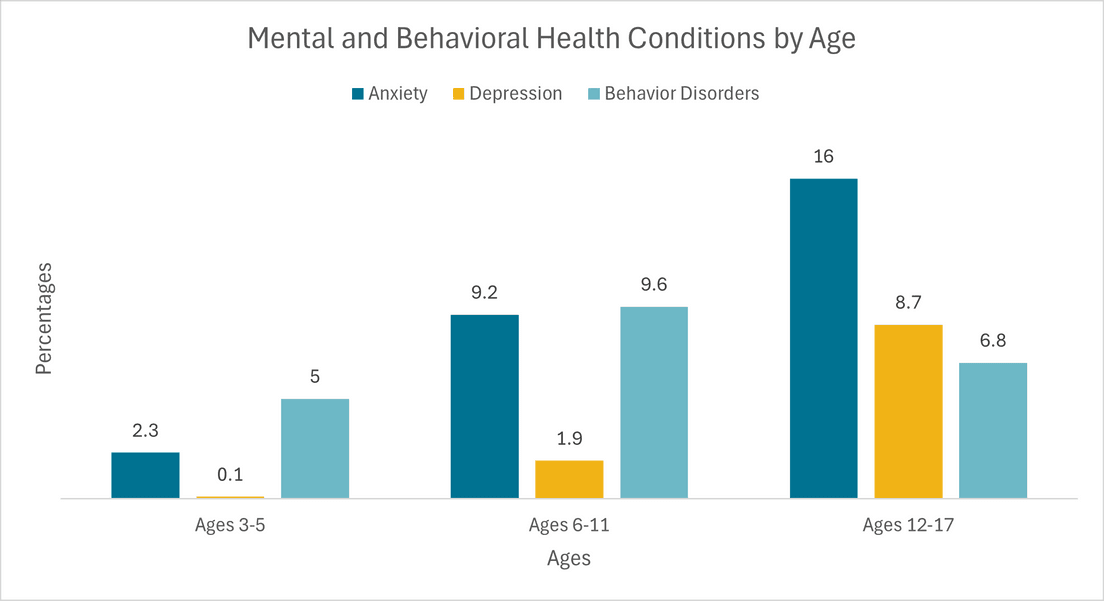
According to the Centers for Disease Control and Prevention, anxiety disorders, behavioral disorders, and depression are the most commonly diagnosed mental disorders in children. The graph below breaks down these conditions by age.
Furthermore;
- 11% of children ages 3-17 had current, diagnosed anxiety (9% of males and 12% of females).
- 8% of children ages 3-17 had current, diagnosed behavior disorders (10% of males and 5% of females)
- 4% of children ages 3-17 had current, diagnosed depression (3% of males and 6% of females).
“Anxiety disorders are characterized by excessive fear and worry and related behavioral disturbances.” -WHO. There are a series of anxiety disorders, including generalized anxiety disorder, panic disorder, social anxiety disorder, separation anxiety disorder, and specific phobias.
Depression is one type of mood disorder in which the individual experiences a persistent feeling of sadness/ depressed mood and loss of interest or pleasure for at least two weeks.
Behavior disorders include Attention Deficit/ Hyperactivity Disorder, Oppositional Defiant Disorder, and Conduct Disorder. Behavior disorders involve a pattern of disruptive behaviors that cause problems in a series of environments.
Resources for these conditions and more are below.
-
The APA has several articles on understanding sexual orientation and gender identity, including articles in other languages.
-
The Anxiety and Depression Association of America (ADAA) raises awareness about the causes of and best treatments for anxiety, depression, and related disorders by disseminating cutting-edge science, promoting evidence-based clinical practice, and educating professionals and the public.
-
The Anxiety and Depression Association of America has released a YouTube video describing anxiety and its day-to-day implications. The Anxiety and Depression Association of America website provides a wealth of information on anxiety, depression, and stress.
-
Anxiety- Suggested Book
"My Anxious Mind: A Teens Guide to Manageing Anxiety and Panic" by Michael Tompkins and Katherine Martinez
-
The Child Mind Institute has numerous articles on youth mental health disorders and concerns for families and educators.
-
This article from The Child Mind Institute provides information about how to help a depressed teenager.
-
Mayo Clinic has released a YouTube video describing depression, it’s prevalence, symptoms, causes, and treatments. The Mayo Clinic website provides additional information and resources for depression.
-
The National Eating Disorders Association is a nonprofit organization that advocates for those that have been affected by eating disorders. There is a wealth of information available on their website about the different types of eating disorders.
-
This website has information on LGBT policies and research. There are also educational tools available.
-
This website has several articles and educational materials about how to create a safe and gender inclusive environment for LGBTQI youth.
-
The International ODC Foundation (IOCDF) provides up-to-date education and resources, strengthens community engagement, delivers quality professional training, and advances groundbreaking research. IOCDF's vision is that everyone impacted by OCD and related disorders has immediate access to effective treatment and support.
-
Use this website to search for any mental health, physical health, safety, wellness topics and more! There is information for parents, kids, teens and educators.
-
Legacy Healing Center has assembled a great page for minority LGBTQ+ young adults and teens, including therapist directories to assist in finding an appropriate provider.
-
The National Institute of Mental Health website contains useful statistics on major depression in adolescents.
-
Provides easy to understand information about mental illnesses, mental health care, diagnosis, treatment and recovery, and support resources.
-
Explore issues that relate to transgender equality, like privacy rights, violence, and bullying prevention.
-
Call 1-888-866-8660
Connects Nebraska families to help when dealing with their children’s behavioral and mental health concerns. Counselors are available 24/7 to help your family in crisis. -
The American Academy of Child and Adolescent Psychiatry (AACAP) website offers many resources that cover all topics within mental and emotional health to families and school professionals. Here, SCIP has linked the AACAP's Parents' Medication Guides to help individuals make informed decisions about treating mental disorders in children and adolescents. This was developed by the AACAP and the American Psychiatric Association (APA).
-
This guide provides tips for parents and teachers on how to promote resiliency in children and teens.
-
Teens are often faced with a significant amount of stress. This article offers tips for teens on how to manage stress as well as tips for parents on how they can help.
-
This site shares parenting styles, reflecting on different ways of relating and communicating with your kids.
-
Learn more information about the different types of mental health disorders including; Social Anxiety Disorder, Bipolar Disorder, Depression and more.
CRISIS LINES:
Nebraska Family Helpline: 1-888-866-8660
Boys Town National Hotline: 1-800-448-3000
National Suicide Prevention Lifeline: 1-800-273-8255
National Teen Dating Abuse Hotline: 1-866-331-9474
National Domestic Violence Hotline: 1-800-799-7233
National Sexual Assault Hotline: 1-800-656-4673
Mental Health Association of Nebraska Helpline: 402-975-2032

